ABOUT THE EDUCATION DEPARTMENT
Driving educational excellence to develop high-quality healthcare professionals.
We support and advance undergraduate education in medicine and health sciences, with a strong commitment to quality, integrity, and international standards.
The Faculty of Medicine Siriraj Hospital, Mahidol University, established an Education Section within the Faculty Secretariat Office in 1972. Professor Dr. Sompothi Pukkaves, then serving as Assistant Head of the Faculty Secretariat Office, pioneered and laid the foundation for the development of educational operations in accordance with the Faculty’s policies.
Following a restructuring of the Faculty’s administration, the Faculty Secretariat Office was renamed the Office of the Dean, and the position of Assistant Head of the Faculty Secretariat Office was renamed Assistant Dean for Education. Professor Dr. Sompothi Pukkaves continued to oversee educational affairs, and Professor Dr. Ukrit Plengvanich was appointed Deputy Assistant Dean for Education. At that time, the Education Section was responsible for both undergraduate and postgraduate education, the Community Medicine Program, faculty development in medical education, and academic conferences. Postgraduate education and academic conferences were subsequently separated into distinct units in 1978 and 1979, respectively.
In 1989, the Education Section was divided into two units. Professor Dr. Paiboon Suthiwan served as Deputy Dean for Educational Services, and Assistant Professor Dr. Uapong Jaturathamrong served as Deputy Dean for Medical Education. The Continuing Education unit (Postgraduate Education) was overseen by Professor Dr. Somwang Danchaivijitr, who served as Deputy Dean for Postgraduate Education.
In 1991, Professor Dr. Arun Pausawasdi, the Dean at the time, restructured the educational administration by appointing Assistant Professor Dr. Uapong Jaturathamrong as Deputy Dean for Education, overseeing three units: Educational Services, Medical Education, and Continuing Education. In 1998, the offices of all three units moved from the 3rd floor of the Administration Building to the 6th floor of the Adulyadej Vikrom Building.
In 2004, Associate Professor Dr. Preyanuj Yamwong was appointed Deputy Dean for Education and continued to administer educational affairs under the existing structure.
In October 2006, Clinical Professor Dr. Piyasakol Sakolsatayadorn, the Dean at the time, made another change to the educational administration. Associate Professor Dr. Soranit Siltharm was appointed Deputy Dean for Undergraduate Education, responsible for Educational Services and Medical Education, while Professor Dr. Banchong Mahaisavariya was appointed Deputy Dean for Postgraduate Education, responsible for Continuing Education.
In December 2007, the Dean’s term changed, while the organizational structure remained unchanged. Associate Professor Dr. Nisarat Opartkiattikul served as Deputy Dean for Undergraduate Education, and Professor Dr. Chairat Shayakul served as Deputy Dean for Postgraduate Education.
In January 2010, Assistant Professor Dr. Mongkol Laohapensang was appointed Deputy Dean for Undergraduate Education.
On September 6, 2010, Mahidol University issued an announcement regarding the division of internal organizational units. Accordingly, the Faculty’s undergraduate education operations were restructured as the Education Division under the Office of the Dean.
On December 9, 2011, Associate Professor Dr. Rungnirand Praditsuwan was appointed Deputy Dean for Undergraduate Education.
On October 1, 2022, Associate Professor Dr. Tripop Lertbunnaphong was appointed as the Associate Dean for Undergraduate Education, a position he holds to this day. He is assisted by 10 Assistant Deans for Undergraduate Education under the administration of the current Dean, Professor Dr. Apichat Asavamongkolkul. Their names are listed below.
Asst. Prof. Suprapath Sonjaipanich, M.D.
Asst. Prof. Weerawadee Chandranipapongse, M.D.
Assoc. Prof. Chantacha Sitticharoon, M.D., Ph.D.
Asst. Prof. Wichit Suthammarak, M.D., Ph.D.
Asst. Prof. Sani Baimai, M.D., Ph.D.
Assoc. Prof. Thos Harnroongroj, M.D., M.Sc.
Asst. Prof. Sirirat Rattanaarpa, M.D.
Rangsima Thinmani, M.D.
Asst. Prof. Somboon Hataiyusuk, M.D.
Key Duties and Objectives
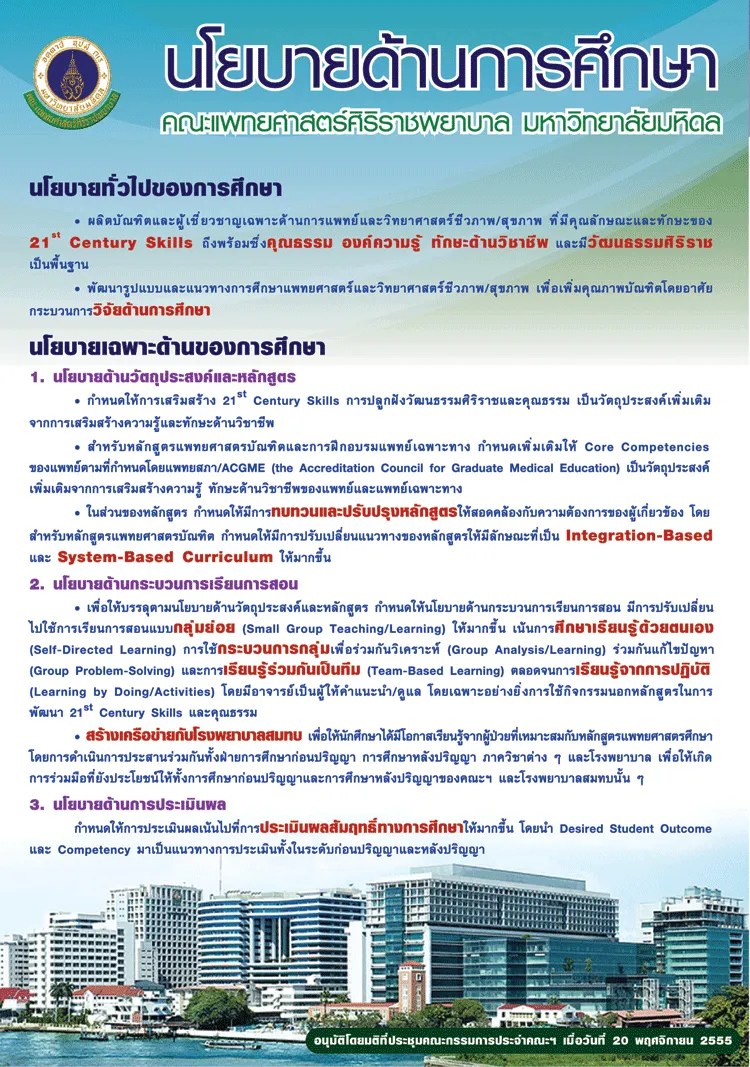
The scope of the Education Division’s operations aligns with the Faculty’s vision and educational policy, aiming to produce graduates and specialists in medicine and biological/health sciences who possess 21st-century skills, are ethical, knowledgeable, skilled in professional matters, and have the Siriraj culture as a foundation. It also focuses on developing models and approaches to medical and biological/health science education to enhance the quality of graduates through educational research.
The Education Division, in collaboration with departments/centers/institutes/schools, is responsible for managing bachelor’s degree and certificate programs in accordance with national higher education qualification standards and the standards set by professional councils.
Education Division
The organization comprises 3 functions, 1 center, and 2 teams: 1) Educational Services, 2) Medical Education, 3) Administration and Support, 4) Center of Excellence in Health Science Education, 5) Strategic and Mission Implementation Team, and 6) System Analysis Team. It has 114 personnel and, in collaboration with departments/institutes/schools, is responsible for producing health science graduates at the undergraduate and lower levels, developing faculty in health science education, and providing educational media and audiovisual equipment. It guides, supervises, monitors, and supports the implementation of faculty-level educational policies to ensure integrated and effective cross-functional collaboration, as well as coordinating support resources with student affairs.
The Educational Services Subdivision comprises three teams: 1) the First-Year Teaching Support and Student Services Team, 2) the Admission and Media Production Team, and 3) the Network Management Team, as detailed below.
The First-Year Teaching Support and Student Services Team manages first-year teaching and learning, registration services, course result processing and evaluation, scholarships/awards for faculty members, special lecturers, and students both in Thailand and abroad, and the preparation of certificates, application forms, and scholarship documents for both domestic and international purposes. The team also coordinates Elective courses and health science curriculum matters.
The Admission and Media Production Team manages student admissions; produces and develops teaching and learning media, innovations, and public relations materials; prepares educational rules and regulations in online formats; updates the education website; organizes program promotion activities such as Open House and Roadshow events; conducts medical student orientation, parent meetings, graduation orientation, activities for medical graduates; and welcomes visiting delegations from external organizations.
The Network Management Team manages teaching, learning, and assessment at affiliated teaching hospitals, community hospitals, and the Golden Jubilee Medical Center. Its responsibilities include allocating physicians for compulsory service, preparing evaluation reports on medical graduates and their employers, conducting site visits and evaluating the Medical Skills Enhancement Program under the Medical Council of Thailand, managing elective courses for 4th- and 6th-year students, and coordinating the preparation of medical students before placements at affiliated/network hospitals.
The Medical Education Subdivision comprises five teams: 1) the Undergraduate and Sub-degree Curriculum Development and Monitoring Team, 2) the Second-Year Teaching Support Team, 3) the Third-Year Teaching Support Team, 4) the Clinical Teaching Support Team, and 5) the Comprehensive Examination and SiCSC Center Team, as detailed below.
The Undergraduate and Sub-degree Curriculum Development and Monitoring Team designs, compiles, analyzes, improves, and reviews the Doctor of Medicine curriculum; coordinates the review of undergraduate and sub-degree curricula, including those of the Faculty’s affiliated institutions; prepares annual program-level educational reports; monitors, verifies, and coordinates revisions to course specifications for general education courses, specialized courses, and practical training courses in the Doctor of Medicine curriculum in accordance with university-prescribed forms; and coordinates teaching and learning activities for SELECTIVE MODULE courses.
The Second-Year Teaching Support Team coordinates class schedules, course instruction, and elective courses for Years 2–3 of the Doctor of Medicine program, organizes pre-semester preparation activities, and reviews/analyzes course examinations.
The Third-Year Teaching Support Team coordinates class schedules, course instruction, and elective courses for Years 2–3 of the Doctor of Medicine program. The team also organizes pre-semester preparation activities, coordinates supplementary classes for NL1 examination preparation, reviews/analyzes course examinations, and organizes meetings of the Preclinical Education Administration Subcommittee.
The Clinical Teaching Support Team coordinates clinical course instruction in the Doctor of Medicine curriculum for courses under the responsibility of the central Education Division. The team organizes meetings of the Clinical Education Administration Subcommittee; coordinates the admission of medical students from other institutions for training/Elective placements within the Faculty; organizes programs promoting blended learning experiences for 5th-year medical students; manages on-call schedules and shift exchanges for Externs; conducts eHis/SiIT training and orientation activities for Externs; organizes forensic medicine training for graduates; coordinates clinical capacity-building activities for 4th- and 5th-year medical students; monitors the recording of clinical procedure training; and reviews/analyzes course examinations.
The Comprehensive Examination Team and SiCSC Center administers comprehensive examinations, including MCQ Clinic, OSCE, MEQ, and Long Case Examinations, for the Faculty and the relevant national medical competency assessment body. The team verifies and certifies examination eligibility and reports NL1–NL2 examination results; plans, manages, and provides equipment for clinical skills and procedure training at SiCSC; recruits and trains simulated patients for OSCE examinations conducted for the Faculty, national medical competency assessment, and teaching purposes; conducts CPR workshops (ACLS, PALS, NCPR) for Externs; and coordinates certification of manual skills and procedures for MD Levels 1–2 with the Medical Council of Thailand.
The Administration and Support Subdivision consists of 6 teams: 1) Administration and Human Resources Team, 2) Procurement and Materials Management Team, 3) Audiovisual Equipment Support Team, 4) Computer Hardware Support Team, 5) Document Preparation and Facilities Maintenance Support Team, and 6) Srisavarintira Center Team. Details are as follows:
The Administration and Human Resources Team handles administrative work, reviews documents submitted to management, manages executives’ appointment schedules, handles human resources matters for the Education Division, prepares office supply requisitions, processes overtime payments, and prepares educational public relations materials.
The Procurement and Materials Management Team plans the Education Division’s budget; manages the procurement of supplies and equipment; handles project disbursements; defines specifications and drafts Terms of Reference (TOR); controls assets; arranges equipment repairs; handles the return of supplies and the borrowing/return of equipment; and coordinates construction projects.
The Audiovisual Equipment Support Team manages audiovisual services in classrooms and meeting rooms; administers classroom and meeting room booking systems; installs projectors; records and edits videos; photographs medical students; records audio; and inspects and maintains in-room equipment.
The Computer Hardware Support Team manages computers and peripheral devices, as well as network systems in classrooms, laboratories, offices, and the Education Division; troubleshoots basic software issues for personnel and students; and manages online teaching, learning, and examinations.
The Document Preparation and Facilities Maintenance Support Team produces teaching and learning materials; cleans classrooms, offices, and educational equipment; prepares classrooms, meeting rooms, and examination rooms both within and outside the Faculty; prepares food for meetings and examinations; and maintains educational simulation models at the SiCSC Center.
The Srisavarintira Center Team provides One Stop Service for audiovisual systems, information systems, cleaning, maintenance, and equipment repair in classrooms, meeting rooms, and laboratories on floors 1–3, 3A, and 5 of the Srisavarintira Building. The team also maintains microscopes and handheld ultrasound devices.
The Center of Excellence in Health Science Education is responsible for providing academic services, supporting educational research, and managing the Master of Science Program in Health Science Education.
The Educational Strategy and Mission Implementation Team is responsible for supporting educational strategies; analyzing, monitoring, and developing systems to collect implementation results in response to recommendations from educational quality assessment committees; compiling data and preparing Self-Assessment Reports (SARs) for educational quality assurance in accordance with relevant educational standards; managing risks and complaints; managing education and scholarships for Pi-shaped programs; supporting student research and educational collaboration with external organizations; developing the capacity of educational support personnel; and managing educational knowledge.
The Systems Analysis Team is responsible for managing and overseeing educational information systems and developing educational software, websites, and databases.
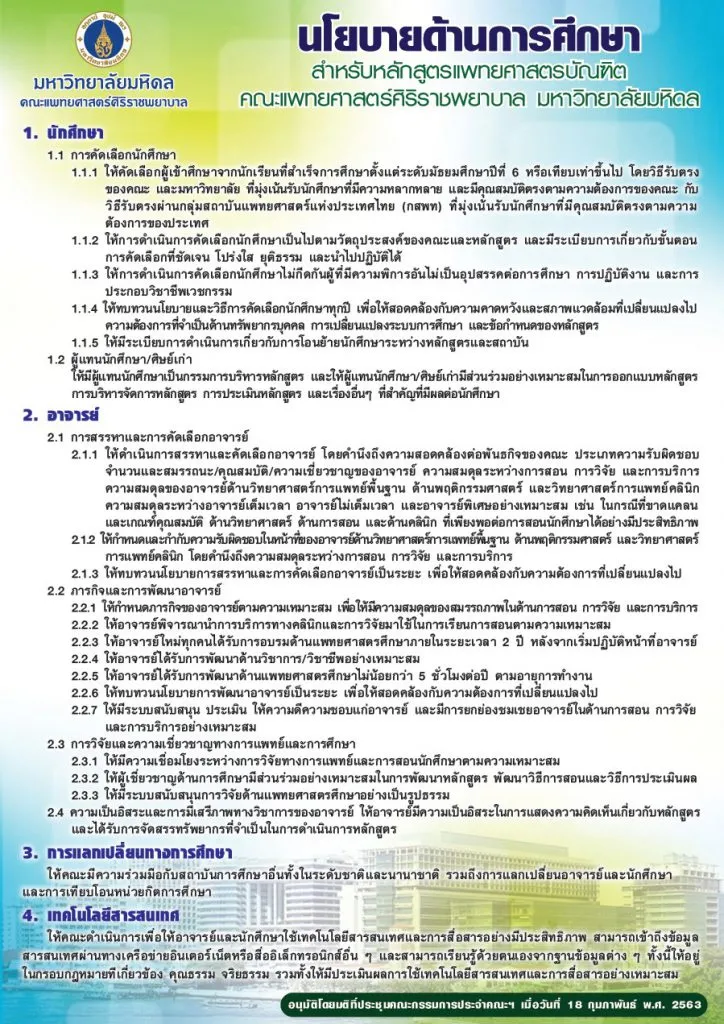
The Faculty of Medicine Siriraj Hospital is committed to providing education that produces high-quality graduates and healthcare professionals at all levels who possess strong ethical values, up-to-date knowledge and skills, and competencies that meet international standards and the needs of the country. The Faculty also strives to earn the highest level of public trust and confidence and to serve as a leader in promoting the health and quality of life of Thai society, as follows:
- The Doctor of Medicine Program encompasses curriculum design and development, student selection and admission, curriculum administration, management of learning support resources, and curriculum evaluation. The educational aims and strategies are to produce medical graduates who:
1.1 Possess knowledge and competencies that meet or exceed the standards for medical practitioners prescribed by the Medical Council of Thailand.
1.2 Have a strong foundation that enables them to pursue further studies in various fields of medicine.
1.3 Possess the competencies required to practice medicine effectively in various healthcare settings.
1.4 Are well prepared to pursue postgraduate medical education.
1.5 Are committed to lifelong learning.
- Provide educational programs in the health sciences at the undergraduate and sub-degree levels, including:
2.1 Bachelor of Applied Thai Traditional Medicine Program
2.2 Bachelor of Technology Program in Medical Educational Technology
2.3 Bachelor of Science Program in Prosthetics and Orthotics
2.4 Bachelor of Science Program in Prosthetics and Orthotics (International Program)
2.5 Bachelor of Science Program in Prosthetics and Orthotics (Blended Distance Learning Program)
2.6 Bachelor of Science Program in Prosthetics and Orthotics (International Blended Distance Learning Program)
2.7 Nursing Assistant Certificate Program (1-Year Program)